
Carbon Fiber Thermoplastic Composites Market Overview
The Carbon Fiber Thermoplastic Composites Market was valued at USD 5.52 Billion in 2025 and is projected to reach USD 11.76 Billion by 2032, growing at a CAGR of 11.4% during 2026–2032, with North America holding the largest share.
Primary Drivers
- Rising demand for lightweight, high-strength materials in aerospace and automotive manufacturing to meet fuel-efficiency and emissions targets is a core structural driver.
- Advantages of thermoplastic composites over thermoset composites - including faster processing, recyclability and weldability - are driving a materials shift in mass-production applications.
- Growth in wind energy, sporting goods and industrial applications requiring high-performance, repairable composite materials is broadening the addressable market.
Primary Challenges
- High production cost of carbon fiber thermoplastic composites relative to metals and thermoset composites limits use to premium, performance-critical applications.
- Complex processing requirements (high melt temperatures, specialized tooling) create manufacturing barriers and raise capital investment needs.
- Limited standardization and certification frameworks for thermoplastic composite structural parts slow regulatory approval in aerospace applications.
This report includes a dedicated chapter covering supply chain exposure, export controls, sanctions risk, and regulatory shifts affecting Carbon Fiber Thermoplastic Composites Market.
Carbon Fiber Thermoplastic Composites Market Strategic Outlook
Carbon fiber reinforced thermoplastic composites (CFRTP) are lightweight materials that display high strength, high elastic modulus, and high potential for low-cost manufacturing or secondary fabrication, which are attractive characteristics for many industrial applications. Fiber reinforced thermoplastic resin composites have a number of advantages such as high fracture toughness, recyclability and possibility to re-melt and reprocess compared with thermo-setting composites. Therefore, the CFRTP is very keen under global environmental issue in which natural resources are effectively used.
Growth trajectory, 2026–2032
How this market is covered
Revenue split by type
Revenue by end use
The introduction of new materials, particularly for aerospace products, is not a simple, quick, or cheap task. New materials and associated processes require extensive and high-cost qualification and must meet challenging manufacturing, strength, stiffness, durability, inspection, and maintenance requirements, as well as emerging recycling-reuse targets, obligations, and directives. Considering the structural design process, a design is traditionally conceived using experience in combination with highly idealized performance models.
Thermoplastic materials typically exhibit high toughness, high service temperature and shorter manufacturing cycle times, as part manufacture does not rely on a chemical process. In addition, thermoplastic raw materials do not have short shelf lives, nor do they require refrigerated storage as with typical aerospace thermosetting resins. Moreover, thermoplastic resins are re-processable, making it possible to efficiently repair local defects in service, an advantage for large, expensive unitised structures.
In regional growth scenario North America Market is expected to hold its strong position for forecasted period. Rise in automobile industry, new infrastructure development, wide application of Carbon Fiber Thermoplastic in aircraft industry are the prime reasons for the growth of market in North America. Since last 5 years European Carbon Fiber Thermoplastic Composites Market has shown tremendous growth due to high demand in Automobile industry. Many Automobile giants like Audi, BMW, Ferrari has adopted heavy use of Carbon Fiber Thermoplastic Materials. Asia-Pacific market is also booming due technological advancement in Automobile & Aircraft which leads to growing demand for Carbon Fiber Thermoplastic Materials. While Africa, Middle East and South American market expected to show constant growth.
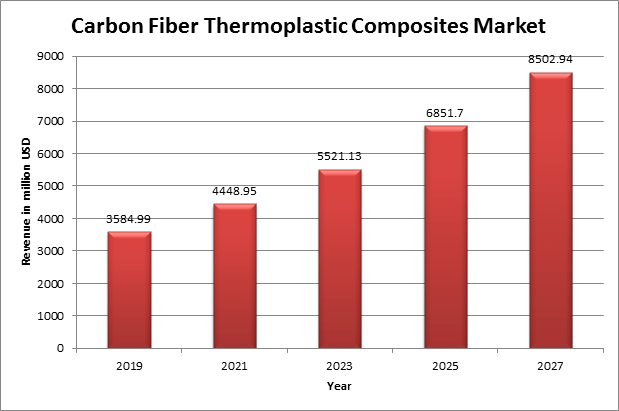
Carbon Fiber Thermoplastic Composites Market: Product Type
- Short Fiber Thermoplastic Composites
- Long Fiber Thermoplastic Composites
- Continuous Fiber Thermoplastic Composites
- Glass Mat Thermoplastic Composites
Carbon Fiber Thermoplastic Composites Market: Vessel Type
- Electrical & Electronics
- Transportation
- Aerospace & Defense
Carbon Fiber Thermoplastic Composites Market : Competitive Analysis
Report includes accurate analysis of key players with Market Value, Company profile, SWOT analysis. The Study consists of following key players in Carbon Fiber Thermoplastic Composites Market :
- Celanese Corporation (US)
- DuPont (US)
- Royal DSM N.V. (Netherlands)
- Koninklijke Ten Cate bv (Netherlands)
- SABIC (Saudi Arabia)
- Lanxess AG (Germany)
- Solvay S.A. (Belgium)
- BASF SE (Germany)
- PlastiComp, Inc. (US)
- PolyOne Corporation (US)
- Quadrant AG (Switzerland)
Geographical analysis of Carbon Fiber Thermoplastic Composites Market:
-
North America
- U.S.A
- Canada
- Europe
- France
- Germany
- Spain
- UK
- Rest of Europe
- Asia Pacific
- China
- Japan
- India
- South East Asia
- Latin America
- Brazil
- Middle East and Africa
Fibers and Composites Landscape
Report Coverage
| Parameter | Details |
|---|---|
| Base Year | 2025 |
| Historical Data | 2020 – 2025 |
| Forecast Period | 2026 – 2032 |
| Base Year Value | USD 5.52 Billion |
| Forecast Value | USD 11.76 Billion |
| CAGR | 11.4% |
| Regional Scope | North America · Europe · Asia-Pacific · Latin America · MEA · RoW |
Frequently Asked Questions
Carbon Fiber Thermoplastic Composites Market was valued at USD 5.52 Billion in 2025 and is estimated to reach USD 11.76 Billion by 2032.
Carbon Fiber Thermoplastic Composites Market is projected to grow at a CAGR of 11.4% during 2025–2032.
Carbon Fiber Thermoplastic Composites Market is dominated by the Electrical & Electronics segment and the North America region holds the highest market share in 2025.
Some of the top key players in the Carbon Fiber Thermoplastic Composites Market are Celanese Corporation (US), DuPont (US), Royal DSM N.V. (Netherlands), Koninklijke Ten Cate bv (Netherlands), SABIC (Saudi Arabia), Lanxess AG (Germany), Solvay S.A. (Belgium), BASF SE (Germany), PlastiComp, Inc. (US), PolyOne Corporation (US), Quadrant AG (Switzerland).
1. Rising demand for lightweight, high-strength materials in aerospace and automotive manufacturing to meet fuel-efficiency and emissions targets is a core structural driver. 2. Advantages of thermoplastic composites over thermoset composites - including faster processing, recyclability and weldability - are driving a materials shift in mass-production applications. 3. Growth in wind energy, sporting goods and industrial applications requiring high-performance, repairable composite materials is broadening the addressable market.
Yes. The report includes a dedicated section on geopolitical risk factors and their impact on supply chains, pricing, and regional demand dynamics.